
Do city pages actually work for contractors?
Short answer: yes. But not the way most contractors build them.
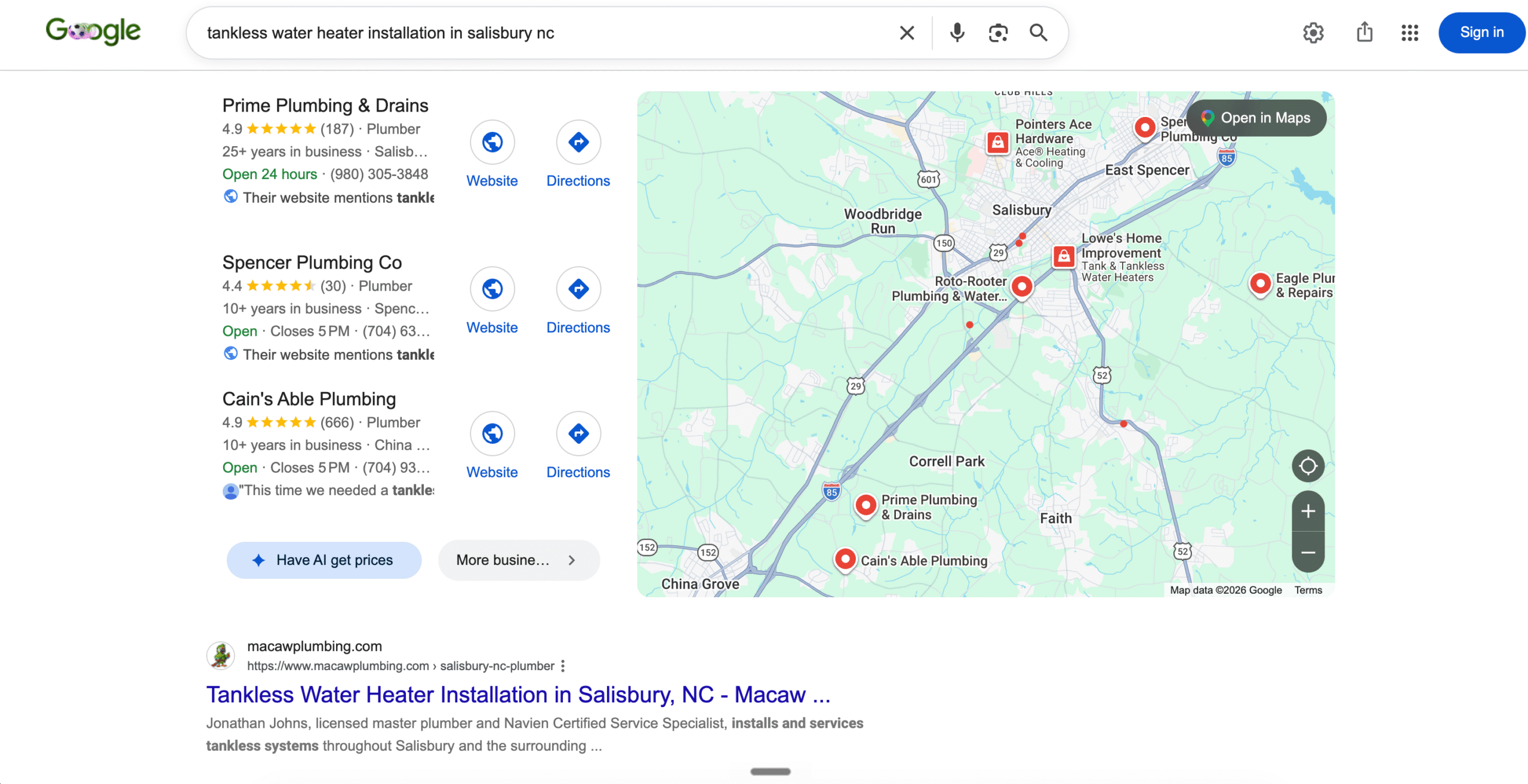
Macaw Plumbing & Tankless operates out of China Grove, North Carolina. No storefront. No public business address. When they came to us, they were a brand new shop that ranked for their company name and their hometown, and nothing else. Three months after launching a new site with properly built city pages, they were ranking #1 in Salisbury, NC, for tankless water heater installations. Salisbury isn’t their home address. They don’t have a shop there. They just have a page that does the job right.
That’s what city pages can do. But for every one that works, there are ten that don’t, and the gap isn’t mysterious.
City pages are one piece of a bigger picture for this trade. The rest of it is in our guide to SEO for plumbers.
Why Most City Pages Fail Before They’re Even Published
When contractors come to me frustrated that their city pages aren’t ranking, I can usually tell what happened before I look at the site. Someone built a dozen location pages in a single afternoon, swapped the city name in each one, and called it a strategy.
These pages look roughly the same: a paragraph about “quality plumbing in [City Name],” a map embed, maybe a paragraph about the town’s history or population. The photos are stock images or the same project photos from every other page. There are no reviews mentioning work done in that city. No case studies from a specific neighborhood or street. Nothing a homeowner in that city would find more useful than a homeowner two counties over.
Google doesn’t penalize these pages so much as ignore them. They’re not manipulative enough to get flagged, they’re just empty. Any competitor could build the same page for any town in the country, and Google knows it.
AI writing tools have made this worse. The temptation to batch 20 city pages in an hour is real, but speed without substance just produces more of the same thin content that clutters the web and doesn’t rank.
Which of these companies would you rather call?
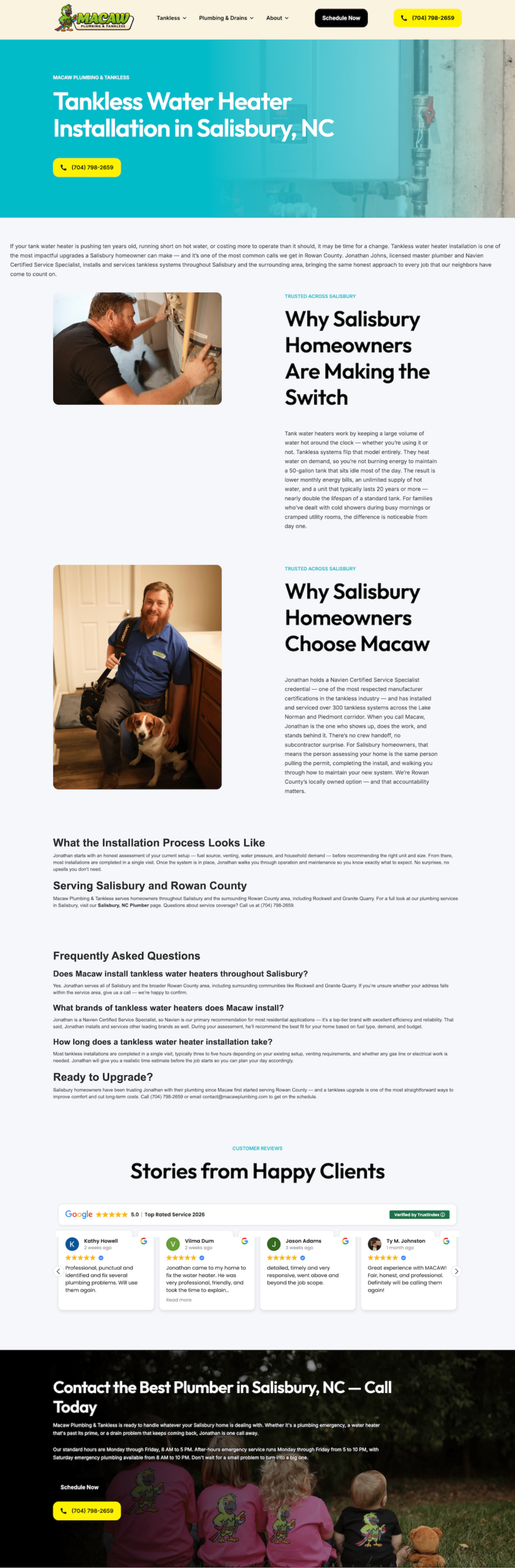
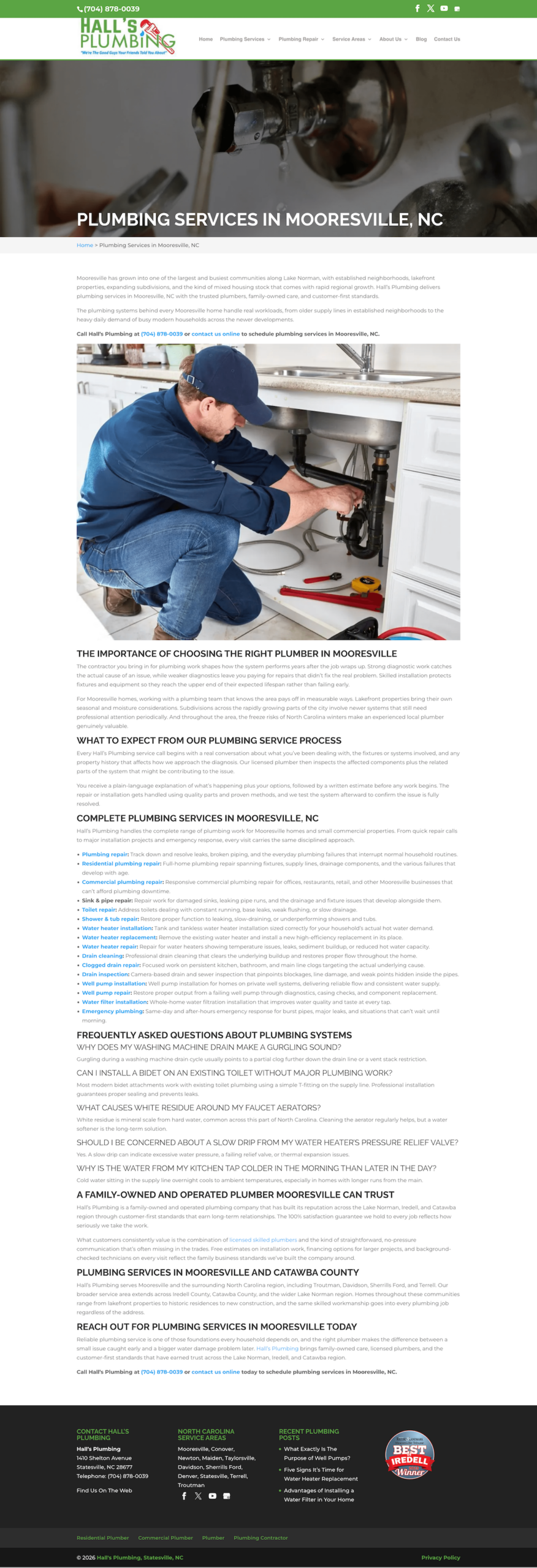
What a City Page Actually Needs
The core question Google is asking about your city page is the same question a homeowner is asking: does this company actually work in my town, and are they any good?
Everything on the page should answer that.
Share specific case studies. If you replaced a water heater on Bringle Ferry Road in Salisbury, say so. You don’t need the customer’s name or address, the street and neighborhood are enough. That level of specificity is experience no competitor can copy and paste, and for route-based trades like landscaping and lawn care it doubles as a way to win the customers nearest the ones you already have. It signals to Google that you didn’t just claim to serve this city; you’ve actually worked there.
Use photos from that job. A welcome sign from the town tells Google nothing. A photo of your van in someone’s driveway on a specific street in that city tells it everything. If you don’t have photos from a project in that town yet, that’s useful information, it might mean you’re not ready to build that page.

Don’t waste the page on the city. Weather, population, local landmarks, homeowners looking for a plumber don’t care. Every sentence that isn’t about your service and your expertise in that service is a sentence that’s working against you.
Use different reviews on each page. Ideally, you want at least one review from a customer in that city who mentions the work done there by name. If you don’t have that yet, use reviews you haven’t used on other location pages. Google notices when the same testimonial appears across your entire site.
Highlight what makes sense for that city. If you do more tankless work in one area and more traditional water heater replacements in another, lead with that. Let the page reflect the actual work you do there, not a generic version of what you do everywhere.
The Map Pack Is a Different Fight
Here’s something worth being clear about: if you’re a service area business without a physical address in a city, ranking in the Google Map Pack for that city is an uphill battle. The map pack tends to favor businesses closest to the searcher. That’s not a bug in the system, it’s how Google has designed proximity to work for local results.

That doesn’t mean your Google Business Profile doesn’t matter. It does. Getting reviews that mention the cities you serve helps. Using those city names in your GBP description and posts helps. Posting photos of your work in those areas helps.
But your realistic ceiling in the map pack is probably one or two cities where you have the best shot, likely your home base and one strong nearby market. Fight hard for those in the map pack. Use your website to rank everywhere else.
The good news is that organic rankings and AI Overviews are different. A well-built city page can rank on the first page of Google Search even without a local address. As Google’s AI Overviews expand, location-based content, articles about what homeowners in that city should watch for, how to find the best service provider locally, what a specific repair typically involves, gets pulled into those results. That’s traffic a map pack listing doesn’t automatically give you.
Which Cities to Build First
This is where most contractors make a second mistake, separate from the thin-content problem: they try to rank everywhere at once.
If you serve five cities and four of them are competitive, start with the fifth. Even if it’s not your home address, even if it’s not your biggest market. Less competition means a faster path to page one, and getting there proves something important to Google: your business is active, your site gets traffic, your reviews are growing. That momentum carries into the harder fights later.
The rifle approach works. Pick one city, build one strong page, get a review or two from customers there, publish a few supporting articles about work you do in that area. Once your domain starts earning authority and your Google Business Profile fills out, add the next city.
Before you build that page, know exactly what you’re targeting. If you work in electrical, our 90+ electrician keyword list is already sorted by service type, use it to choose your page title before you write a single word.
Building 20 location pages at once also creates a content problem you can’t solve honestly. If you haven’t done much work in 15 of those cities, you don’t have the case studies, the photos, or the reviews to make those pages real. Better to grow your digital presence the same way your actual business presence grows, one city, one proof point at a time.
What Macaw’s Results Actually Mean
Ranking #1 in Salisbury for tankless water heater installations didn’t happen because we found a shortcut. It happened because the page earned it. Specific work history. Real service descriptions. Content a homeowner in Salisbury could actually use to make a decision.
That’s the version of city pages that works. It takes longer to build than a batch of templates, but it’s also the version Google can’t ignore.
If you’re not sure where to start or want an honest look at what your current site would need to rank in your service area, book a free Digital Strategy Session, we’ll walk through it together.
FAQ
Do city pages really help contractors rank in cities where they don’t have an office?
Yes, but only if they’re built with specific, useful content. Google needs to see that you actually serve that city, real work history, real photos, real reviews. A page that just lists your services and swaps in a city name won’t rank.
How many city pages should a contractor build at once?
Start with one or two, depending on where you already have work history and reviews. Building 20 pages at once usually means spreading thin content across too many pages. As your business grows and you accumulate more proof from each area, add pages that can actually support that city.
Can a service area business rank in the Google Map Pack without a local address?
It’s possible but unlikely in competitive markets. The map pack favors proximity. Focus on organic rankings and Google Search for cities where you don’t have a local address, that’s where a well-built city page can actually compete.
What’s the difference between a city page that ranks and one that gets ignored?
Specificity. The pages that rank have case studies from specific streets or neighborhoods, photos from actual projects in that city, and reviews that mention the work done there. The pages that get ignored are interchangeable, you could replace the city name with any other city and the page would look identical.
How long does it take for city pages to rank?
For Macaw Plumbing & Tankless, we saw first-page rankings for some towns within two months of launching a new site, and the #1 ranking for Salisbury came around the three to four month mark. That timeline is realistic for a well-built site in a mid-competition market, not a guarantee.