
This week I opened ChatGPT, logged out, and typed: "give the top tankless water heater companies in concord nc."
It gave me five names. The first three were what you'd expect: a water heater specialist that serves the whole Charlotte area, and two Concord plumbing companies with Concord addresses and 938 and 472 Google reviews.
Fourth was Macaw Plumbing & Tankless, a client of mine. Macaw is Jonathan Johns, the only plumber in the field, based in China Grove, a couple of towns up the road. At the time it had 93 reviews and no Concord address. ChatGPT described it as "a particularly relevant option for tankless expertise, troubleshooting, maintenance, and Navien systems," and then put it in its three "starting picks" for "tankless-focused expertise."
A tenth of the reviews. Not in the town. Still on the shortlist, and named for something.
That's not luck, and it isn't a trick. It's what happens when the same claim about a business shows up in enough places that a machine can check it. This article lays out where those places are, which ones matter most for a contractor, and how to use them to get recommended for the work you actually want.
The short version
AI tools don't rank contractors the way Google's ten blue links do. They run a reference check. Before they name a business, they look for the same facts in more than one place: what you do, where you do it, and what you're best at.
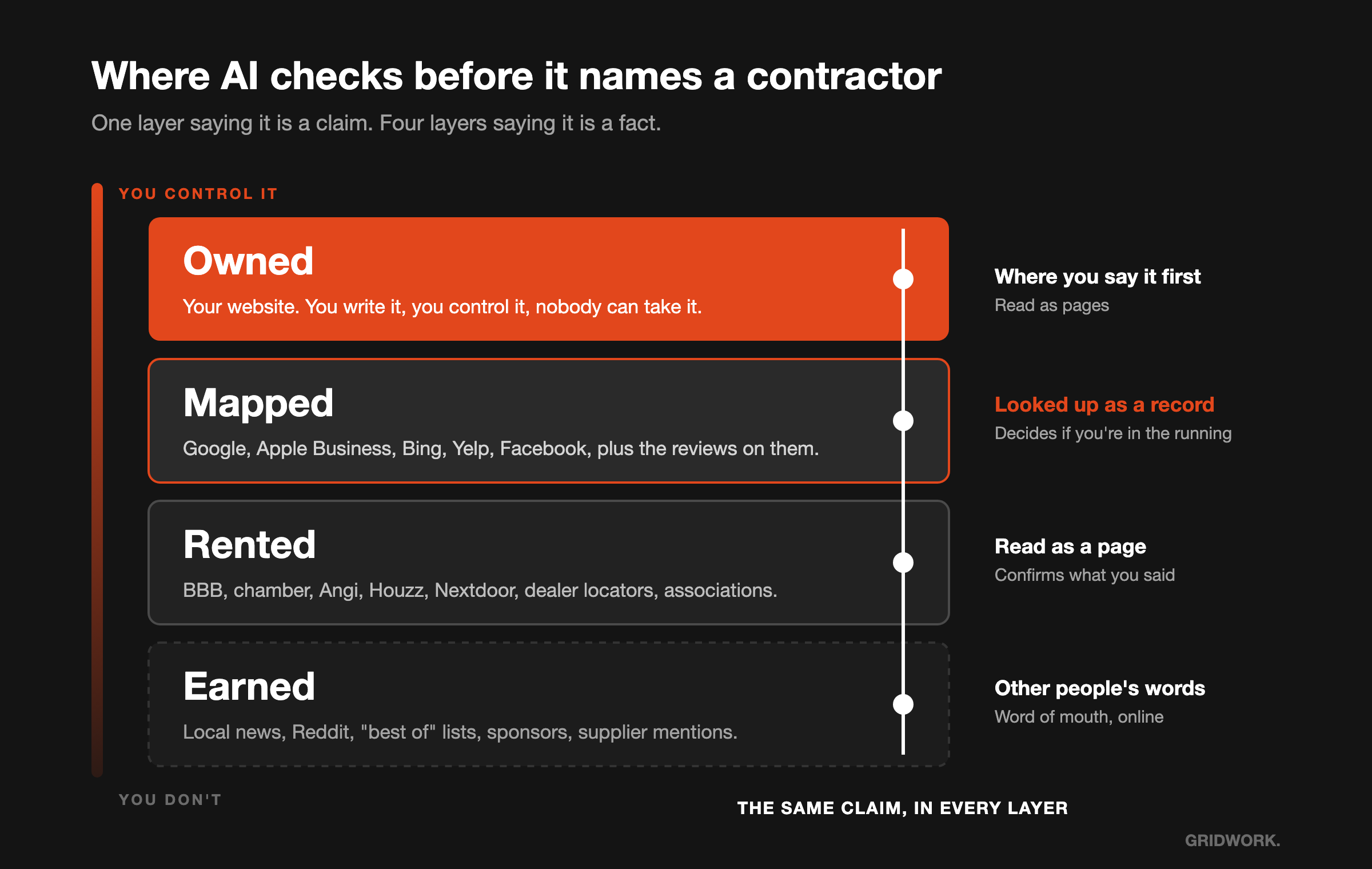
For a local contractor, those places come in four layers:
- Owned. Your website. You write it, you control it, nobody can take it.
- Mapped. Your map profiles and the reviews attached to them: Google Business Profile, Apple Business, Bing Places, Yelp, Facebook. AI tools look these up as structured records.
- Rented. Profile pages on someone else's site: BBB, your chamber, Angi, Houzz, Nextdoor, manufacturer dealer locators, trade association directories. You fill them out, but you don't own them.
- Earned. What other people say about you: local news, Reddit threads, "best of" lists, sponsor pages, supplier mentions.
One layer saying something about you is a claim. Four layers saying it is a fact. And because you control most of what those layers say, you have real control over what you get recommended for.
Why "don't build on rented land" is wrong here
There's a piece of marketing advice that's been around forever: don't build on rented land. Put your effort into your own website and email list, because the platforms can change the rules on you overnight.
It's good advice, and for a local contractor it's half wrong.
You can't skip the rented and mapped layers, because that's where AI tools are looking. A contractor with a beautiful website and a neglected Google profile is invisible in the places that decide whether they get named. The rule isn't "avoid rented land." It's "don't only build there, and make sure everything you build there agrees with the house you own."
How AI actually finds a local contractor
Here's what's going on under the hood, in plain terms.
- Google's AI answers (AI Overviews, AI Mode, Gemini) draw on the same Business Profile data that runs Google Maps. For local questions, the profile is the record.
- ChatGPT searches the live web for local questions, leans heavily on Bing, and pulls business data from partners like Foursquare. In 2026, Yelp licensed its content to OpenAI: about 330 million reviews and more than 8 million business listings.
- Apple Intelligence and Siri use Apple Maps, which is fed by Apple Business.
All of these tools cross-check. If your name, hours, service area, and categories say one thing on Google, another on Yelp, and a third on your website, the tool's confidence in you drops, and so do your odds of being named.
So for a local service business, the main thing AI is checking isn't really the web. It's the map. You can write the best article on the internet about tankless water heaters and still never get named, because the record the tool relies on is incomplete, in the wrong category, or contradicted somewhere else.
That's also why the mechanism isn't just exposure. Getting seen matters, but what gets you named is corroboration: your site says it, your map profile confirms it, your reviews describe it in a customer's words, and somebody else's page repeats it.
This is already changing how customers find contractors. According to BrightLocal's 2026 Local Consumer Review Survey, 45% of consumers used AI tools to find local business recommendations in the past year, up from 6% the year before.
Tier 1: Owned (your website is your conversation)
Everything else in this framework confirms or repeats something. Your website is where you say it first.
It's also the only layer where you can talk the way you'd talk to a customer on a site visit. Every platform below this one squeezes you into its fields: a category, a few services, a short description. Your website is the only place you can say, "These are the customers we're best for, these are the jobs we love, and if this isn't you, we're probably not the right fit." That filter is how you get the important calls instead of all the calls.
People ask AI tools full questions, not keywords. (I wrote about that in AI Search Is a Conversation, Not a Keyword.) The details in those questions are what the tool tries to match, so your site needs to carry the details. Most contractor sites leave out exactly the things customers ask about. Yours should be current down to the week:
- your hours this week, and the holidays you're off
- the name of the person who'll answer the phone
- how long before you call back if you miss a call, and how to leave a message
- how far out you're booking right now
- the types of calls you take, and the ones you don't
- the calls you'll gladly run on a Saturday, and the ones you'll schedule for Monday
- the towns and neighborhoods you work in, and the ones you don't
None of that is clever. It's what a good office manager tells people on the phone. It just has to be written down where a machine can read it.
Macaw's pricing page is a good example. It lists real installed prices for tank and tankless water heaters, the service call fee, and the after-hours fee. A homeowner in October called after reading it, already knowing the dispatch fee, ready to book. As Jonathan put it, that's exactly the site he wants: people show up knowing the information, and the ones who won't use him don't call.
If you want the full order to build a contractor website in, I laid it out in SEO for Contractors: The Order You Build It In.
Tier 2: Mapped (the record AI checks first)
Mapped is your map profiles: Google Business Profile, Apple Business, Bing Places, Yelp, Facebook, and the reviews attached to them. The reviews belong in this tier, not in a separate one. The platforms show the pin and the stars as one unit, and the AI tools pull them together.
What makes this tier different from Rented is how AI reaches it. These aren't pages that get read like an article. They're records that get looked up: name, category, service area, hours, rating. If you're in the wrong category or missing from the platform a tool relies on, you're not outranked. You're not in the running at all.
What to set on your Google Business Profile, and how often
Everything on the profile matters to some degree. Some of it you set once, and some of it needs a regular look.
| Item | How often | What I tell clients |
|---|---|---|
| Primary category | Once | Hugely important. Get it right, then leave it. |
| Secondary categories | Once | A couple that are common sense. Don't stack ten. |
| Service area | Once | Your city or a few counties around you. The whole state at most. Never the whole country. |
| Services | Every 6 months | Google adds new service options fairly often. Check for new ones that fit. |
| Description | Every quarter | Make sure it still matches your website and your positioning, not just what you do and where. |
| Photos | A couple every week | Lead with your truck, your face, your logo, your shop (front door and inside, if you have one), and you working in a customer's home in a company shirt. Set it up as if someone were walking into your business. |
| Products | Once per priority service | A real Product for each job you want more of, with a photo, a description, and a link to that service page. It matters most in the Maps app, which is where a lot of these searches happen. |
Then do the same for Apple Business, Bing Places, Yelp, and Facebook, and make them all say the same thing your website says.
Own your profiles
This sounds obvious, and it's the problem I run into most.
I'm working with a company right now that has three showrooms and doesn't have owner access to any of its Google profiles. The reviews are there, but nobody can touch the listings. We can't update hours or fix the description. They're trying to close one showroom, and we can't even mark it closed, because nobody at the company has the rights to it.
The fix is simple to say: you're the primary owner of every profile, and your marketing company or freelancer is added as a manager. (Here's how to add a manager to a Google Business Profile.) If your agency owns your profiles, you don't.
When Google won't cooperate
The worst profile mess I've inherited was a national software company that had moved its headquarters from New Jersey to South Carolina. Real company, real South Carolina address. They couldn't get the profile changed for months, and Google never once got back to us.
The cause turned out to be several people, in several Google accounts, all requesting the same change at the same time. Google froze it. Fixing it meant finding out who'd requested what, withdrawing every request but one, and getting the new address confirmed elsewhere: on other directories, and by real people (employees and visitors) finding and visiting the new location on Google Maps. Once Google could see the address from more than one direction, the change went through.
Two things stuck with me. First, Apple approved the same listing in a day. Second, when Google is stuck, repeating the same request doesn't help. Corroboration does. Get your current address and information onto as many other trusted sources as you can, make sure it matches your website, and Google eventually catches up.
The cost of "set it and forget it"
I see this all the time with long-running contractor companies. They're busy running good businesses. Then one day they look at their Google profile, or Apple Maps, or Yelp, and it's advertising services they don't even want to do anymore. They're annoyed by calls for low-margin jobs, and they don't realize they're the ones marketing those jobs.
Every profile you have should say the same thing, and it should be the thing you want: "We install and service tankless water heaters." "Residential only." "Commercial only." Say your real hours. If you close for lunch, say so, because unanswered calls through your profile tell Google you might not be in business anymore. And if the owner retired, the phone number changed, or you started or stopped using call tracking, update every profile. A wrong phone number on a map listing is a lead you'll never know you lost.
Tier 3: Rented (pages you fill out but don't own)
Rented profiles are pages on someone else's website: BBB, your chamber, Angi, Houzz, Nextdoor, manufacturer dealer locators, trade association directories. You write the copy and pick the photos, but they're read like any other web page, and the owner of the site makes the rules.
Some of these carry star ratings too. Angi, Houzz, and Nextdoor all do. I still put them here, because the test isn't whether a platform has reviews. It's whether AI tools look it up as a business record or read it as a page.
Rented profiles are great, but they're only great until they're not. You don't control when the apps change. You don't control which businesses they highlight. One year they feature the plumbers who've been in business ten years. The next they feature the ones who pay for placement. Even if you're the best plumber in town, they can't tell. They default to whatever data they have, and they're all in business to make money. That's not a reason to skip them. It's a reason not to depend on them.
Which ones are worth your time
All of them help to some degree, but almost none of them pay off fast. If you're signing up for several, expect most of the value a year out. What you're building is the network of places that confirm who you are. Here's how I'd rank them:
- Manufacturer and dealer locators. Get on every one you qualify for. A listing as a certified Navien service company confirms your specialty, with the manufacturer's name behind it, and usually links back to your website. If your site says "I'm a tankless expert," a manufacturer saying so too is huge. It also sends work: last quarter, a homeowner found Macaw on Navien's dealer list. It was the only name on the list with "tankless" in it, 19th down, around page three. She went to his website, it "pushed her over the edge," and she paid the out-of-area fee for a $658 job.
- One local chamber or builders association. Pick one where you'll also meet people in person. You get a strong local link and a room full of potential referrals. In small towns, some chambers run $250 to $300 a year. I'm in two and they're worth it to me. If you only work for homeowners, the case is weaker unless you also want commercial work. (More on local organizations and sponsorships.)
- A free BBB profile, today. Listing is free. They'll want a phone call with you. You only pay for accreditation, which is optional.
- Free profiles on Angi, Houzz, Nextdoor, and local directories. Set them up and fill them out completely. It's a quantity game, so don't expect much from any single one. Nextdoor can be worth real effort if you want to be the neighborhood's go-to guy.
The best of these do two things at once: give you a link from a trusted site, and put you in front of people who might hire you or tell their friends about you. That's why a good local chamber beats most paid directories.
Tier 4: Earned (what other people say about you)
Earned is everything you don't control: local news, trade publications, Reddit and Facebook group threads, "best plumbers in [town]" roundups, sponsor pages, a supplier or a builder mentioning you.
AI tools are trying to recreate word of mouth. Someone will always trust what a neighbor says about you more than what you say about yourself, and the tools work the same way. When they look for who to recommend, they look for who other people are talking about, sometimes with a link and sometimes just by name.
You can't manufacture this layer, but you can make it more likely. Sponsor the 5K. Partner with a builder and let them talk about it. Do something worth mentioning in your community and tell the local paper. Ask happy commercial customers if you can be named as their vendor. It's slow, and it compounds.
A footnote, not a tier: the technical stuff
Schema markup, FAQ sections, clean headings, and llms.txt files all come up in AI search advice. They help. Structured pricing is one reason Macaw's pricing page is easy for a machine to quote.
But they're scaffolding, not foundation. Schema on a site that says nothing specific about who you serve and what you do is a well-labeled empty box. Do the four layers first.
Being found isn't the goal
Almost every article about AI search stops at visibility: get mentioned, get named, get the click. For a contractor, that's the wrong finish line.
When you're starting out in the trades, you take whatever work comes in. You re-roof the shed. You unclog the toilet. You keep the crew busy, and you meet the homeowner who'll call you in five years when it's time to remodel the bathroom. Everyone does that, and they should. It's the initiation period.
But once you're busy, being able to do more of the work you love is a massive mark of maturity and profitability. Maybe it's more efficient, so it's more profitable. Maybe customers care more about it and pay more for it. Either way, the goal stops being "get found by more people" and becomes "get found by the right people, for the right job."
Two jobs, same plumber
Say you're a plumber who wants to do tankless water heaters, but your website lists everything down to drain cleaning and new sink faucets. You'll get a mix of every job type. If you're booked for two faucet swaps that pay a few hundred dollars each, you're not free the day someone's water heater dies and they've decided today's the day they go tankless. That's a $1,500 job with a customer who'll likely call you again, and it went to someone else.
The economics run deeper than the ticket. Installing a toilet means you're always paying for the product. Drain cleaning, once you've bought the equipment, is all service. And sometimes the drain call is the door to the big job: the toilet that won't flush turns out to be a collapsed clay pipe, and now you're replacing the line all the way to the street, a five-figure job that started with a plunger.
So you can't know which small jobs to keep until you know what you want to be known for.
What AI does with what you say
This is where the four layers become a steering wheel. Your primary category, your service list, your Products, your specialty pages, the reviews you ask for, the photos you post, the jobs you write about: all of it shapes what you get recommended for.
Being recommended for "emergency drain cleaning" and for "whole-home repipe" are two different businesses with two different margins. Most contractors let the platforms decide which one they are. You can decide.
You're never going to outgrow the biggest plumbing company in town. But you can be known as the generator guy, the Tesla charger electrician, or the tankless plumber who knows Navien better than anyone around. You have to say it over and over, in every layer, and stop cluttering your site with every small job that might come in on a rainy day. If you get really good at one thing, you'll never go hungry.
A firm that got narrower and did better
Creek Engineering has been serving Southwest Florida since 2002, starting as a geotechnical testing firm doing field testing for other engineers. When they reorganized a few years ago and started hiring engineers, they first took on everything: structural, pool design, any engineering that came in. They learned fast that some of it they couldn't win against firms with dozens of engineers and offices everywhere, and some of it wasn't profitable enough to be worth the time.
So they got clear. Geotechnical testing, soil compaction especially, because of Florida's soils and environmental rules. Septic design, because septic is a serious issue in Florida with the water table sitting right under the houses. Hardly any other firms were focused on those. Once Creek was, contracts with developers followed, then homeowner calls and more developer calls. Now they're growing into civil, site work, and environmental engineering from that base.
They didn't beat larger firms by being bigger. They beat them by being the experts: boots on the ground, knowing the permitting agencies and the process cold, and committing to educating their clients. Creek isn't a contractor, but the play is the same.
What it looks like in practice
Macaw has been my clearest test case for all of this. The numbers are small, which is honest for a one-plumber business, but look at what they're made of.
- May 2026: Jonathan told me, "What we're doing is working. I've gotten two calls from AI." He was showing in the top three of Google's AI results for searches from China Grove.
- April 2026: Google's AI called the shop asking about pricing. The person who answered gave a clear, honest answer: where prices start, where they top out, and that they usually run same day or next day. Three days later, Google was showing that answer almost word for word.
- September 2026: A ChatGPT lead for a tankless water heater that wasn't working, in Huntersville, a town where Macaw didn't have a page yet. The specialty carried it.
- Year to date, October 2026: Housecall Pro shows $10,000 in revenue from Google, $1,000 from ChatGPT, and $188 from Gemini.
And that Concord result at the top of this article: named for tankless, with a tenth of the reviews, from outside the town.
It's happening on my side too. In September, a contractor booked a strategy session with me after asking ChatGPT who else was "specific for contractors, maybe more smaller boutique style." It gave her two names, and I was one of them. She was the second prospect in six weeks who found me through AI. She didn't search "SEO agency." She described what she wanted, and my site, profiles, and articles said the same thing about me in enough places to match it.
Where to start
If you're doing this yourself, go in this order:
- Claim and own every map profile. Google, Apple Business, Bing Places, Yelp, Facebook. You're the owner, anyone helping you is a manager.
- Decide what you want to be known for. One or two jobs, and the towns you want them in. Write it down before touching anything else.
- Make your website say it, specifically. A real page for each of those jobs, plus the week-to-week details customers ask about: hours, who answers, how far out you're booked, what you do and don't take.
- Make every map profile match. Primary category, services, Products for your priority jobs, description, photos, hours. Then put it on the calendar: services every six months, description every quarter, photos every week.
- Ask for reviews that describe the job. "Jonathan replaced our tank with a Navien in one afternoon" does more than "great service."
- Fill in the rented layer. Every dealer locator you qualify for, one chamber or builders association, a free BBB profile, then the rest as time allows.
- Give people a reason to talk about you. Sponsorships, partnerships, community work, local press. This one never ends.
Expect the map and website work to show up first and the rented and earned layers to pay off over a year or more. When it does, a lot of it will show up as people searching your name, which is why your homepage gets the credit. It's a long-term play, which is also why most of your competitors won't do it.
If you'd rather have someone run it with you, that's what my AI search optimization work does. If you want to start with step 2, book a free strategy session and we’ll pick the jobs you want to be named for.
Own your expertise
Take your specialty seriously. It's more valuable than you realize, and there's a good chance people don't know what you specialize in, because you haven't said it anywhere they'd look.
Everyone's buried in messages all day. So make every message your business sends support that specialty, and show (don't just tell) how, why, where, and when you're the best at it. People care more than you realize, and AI search tools definitely do.
FAQ
How do I get my contracting business recommended by ChatGPT?
Make the same specific claim about your business in four places: your website, your map profiles and reviews (Google, Apple Business, Bing, Yelp, Facebook), rented profiles like dealer locators and your chamber, and earned mentions from other people. ChatGPT relies on Bing, data partners like Foursquare, and licensed Yelp data, so your Bing and Yelp listings matter more than most contractors assume.
Is Google Business Profile still the most important thing for AI search?
For Google's own AI answers, yes, because they draw on the same Business Profile data that runs Maps. It's not the only record that matters, though. ChatGPT and Apple rely on other sources, so your information needs to match everywhere.
Do reviews matter for AI search?
Yes, and what they say matters as much as how many you have. A review that describes the specific job gives an AI tool something to match against when someone asks for that job. In my Concord test, a plumber with 93 reviews was named for tankless next to companies with 938.
Are Angi, Houzz, and Nextdoor worth it?
Set up free profiles and fill them out completely, but don't count on them. They're rented: useful for confirming who you are, slow to pay off, and subject to whoever owns the platform. Manufacturer dealer locators are almost always worth more.
Does schema markup help with AI search?
It helps machines read what's already on your page, so it's worth doing. It won't make up for a site that never says who you serve, what you do best, and where.
How long does this take to work?
Website and map profile fixes can show up within a few months. Rented and earned layers usually take a year or more. Treat it as a long-term foundation, not a campaign.