

Most contractors I talk to are good at their trade. Really good. But when it comes to getting found online, they’re either doing too much, doing it in the wrong order, or doing nothing at all because nobody’s ever laid it out plainly.
This checklist is the plain version.
It’s what I’d walk through with any home-service contractor who wants to show up in local search, build consistent leads, and stop relying on word-of-mouth to keep their schedule full. You don’t need to do all ten things at once. You need to do the right things in the right order.
Let’s get into it.
1. Find Your One Target Keyphrase
Before you do anything else, identify the single most important search phrase for your business.
Not thirty phrases. One.
I call it your primary keyword, and it’s almost always obvious: what you do, and where you do it. “HVAC company Asheville.” “Plumber Charlotte.” “Electrician Knoxville.” That’s it.
Here’s why this matters: when you build everything around one core phrase, the other related phrases start to rank on their own. But when you spread your energy across dozens of phrases from the start, nothing gains traction. You end up with a website that whispers everything instead of shouting the one thing.
Pick one. Write it down. Every decision you make from here should connect back to it.
2. Make Your Who, What, and Where Crystal Clear
This sounds basic. It is basic. It’s also the step most contractor websites get wrong.
Search engines need to know three things immediately: who you are, what you do, and where you serve. If any of those three are unclear, your rankings suffer and your leads dry up.
Run this quick test on your own website. Look at your homepage and ask: if a stranger landed here for the first time, would they know in five seconds who you are, what you do, and what city or region you serve?
If the answer is no, that’s the first thing to fix.
This same principle applies to your Google Business Profile, your directory listings, and anywhere else your business shows up online. Consistency and clarity on those three points builds trust with Google and with real people.
3. Your Website Is a Roadmap — Treat It Like One
Most contractor websites are organized around the business owner, not the customer.
They’ve got a homepage, an about page, a contact page, and maybe one generic “services” page that lists everything they do in a single block of text. That structure feels complete. It isn’t.
Here’s how to think about it instead: your website is a roadmap. Every road on that map leads to one specific destination. And every destination needs its own address.
That means one page per service. One page per location.
If you do HVAC installation, HVAC repair, and duct cleaning, those are three different pages. Not three bullet points on one page. Three pages, each built around the specific search phrase a homeowner in your market would type when they need that exact service.
The same goes for your service area. If you serve Asheville, Weaverville, and Black Mountain, that’s three different location pages. Not one page that says “we serve the greater Asheville area.” Three pages that speak directly to what you do in each of those towns.
Why does this matter? Because when someone in Weaverville types “HVAC repair Weaverville,” Google needs a page that answers that specific question. If that page doesn’t exist on your site, you’re invisible for that search. The competitor who built that page gets the call.
Start with your hometown. Own it before you expand.
Here’s my full SEO guide for contractors in Asheville.
Before you build out pages for every town in your service area, make sure your primary city is locked down. That means a dedicated service page for every major service you offer, all targeting your hometown. Get those ranking.
Establish your authority in the market you know best.
Once your hometown is solid, move to your next highest-priority service area and build the same structure there. One page per service, one page per location, working outward from your home base.
This approach does three things at once:
- It gives Google a clear, organized signal about exactly what you do and exactly where you do it
- It gives every potential customer a page that speaks directly to their specific need and location
- It compounds over time, so every new page you add builds on the authority of the pages already ranking
Think of it as your who, what, and where applied at the page level. Not just for your business as a whole, but for every specific service you provide, in every specific town you serve.
A contractor with forty well-built pages targeting specific services and locations will outrank a contractor with a beautiful five-page website every single time.
The map doesn’t have to be complete on day one. It just has to be organized and keep growing.
4. Fix Your Website Foundation Before You Promote Anything
Your website is your most important lead-generation asset. Not your social media. Not your yard signs. Your website.
Before you put money into ads or time into content, make sure the foundation is solid. That means:
- Fast load times on mobile
- Clear calls to action on every page
- Service pages built around specific keywords (see step 3)
- Your name, address, and phone number consistent everywhere
- Real photos of your team, your work, your trucks
If your site is slow, confusing, or missing basic information, no amount of traffic will fix the problem. You’ll just send people to a dead end.
Want to keep learning more? I share tips to get found every Friday in The Momentum Brief, our free weekly newsletter for home service contractors.
5. Get Your Google Business Profile Right
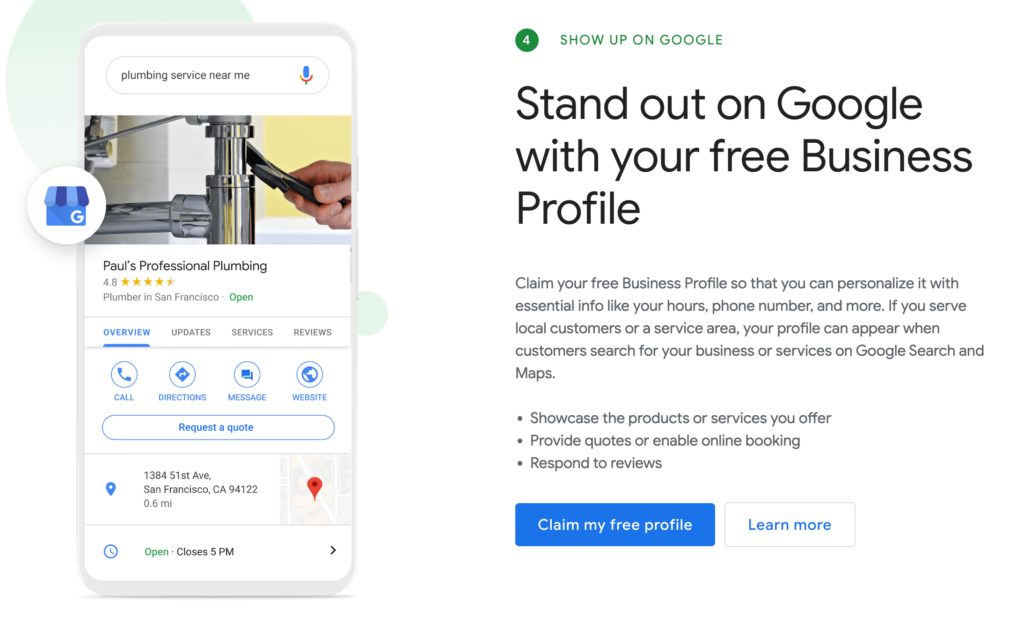
For most home-service contractors, your Google Business Profile drives more leads than your website. It’s the first thing people see when they search for someone like you in your area.
Most GBP listings I audit are incomplete, inconsistent, or neglected. That’s a problem you can fix today.
Start here:
- Make sure every section is filled out completely
- Choose the right primary category for your trade
- Add real photos of your work regularly
- Collect reviews consistently and respond to every one
- Post updates at least once a week
If you want to know where you stand, compare your listing side by side with the top three results in your market. Look at what they’re doing that you’re not. The gap is usually obvious.
Check out our full guide to setting up your Google Business Profile.
6. Tell People What You Do
This one feels too simple to mention. I mention it anyway because most contractors skip it.
You know people. Neighbors, church members, former customers, people you went to school with, people you coach youth sports with. Most of them have no real idea what you do for a living beyond a general category.
Send an email. Post something honest on Facebook. Text a handful of people you haven’t talked to in a while. Tell them what you do, where you work, and who you help.
Something like: “Hey, I’ve been doing HVAC service in the Asheville area for twelve years. If you or anyone you know ever needs help, I’d love to earn the work.”
That’s it. No pitch. No discount. Just a reminder that you exist and what you’re good at.
Organic word of mouth builds on itself. But it only builds if people know to send it your way.
7. Build a Few Real Business Relationships
Find three to five other local businesses that serve the same customers you serve but don’t compete with you.
If you’re a plumber, think electricians, HVAC companies, general contractors. If you’re a roofer, think painters, gutter companies, and insurance agents who handle claims.
Don’t pitch them. Don’t start with “how can we exchange backlinks.” Just get to know them. Show up to the same chamber events. Refer work their way when it comes up naturally. Support each other online.
Over time, these relationships turn into referrals, shared audience, and mentions on each other’s websites and social platforms. It’s the organic version of word-of-mouth, scaled beyond your personal network.
The contractors who build these relationships consistently are the ones who never run out of work.
8. Invest in Your Local Community — and Get Credit for It Online
This step is more important in 2026 than it’s ever been, and most contractors completely overlook it.
Google Maps is no longer the only place customers find you. AI-powered search tools like ChatGPT, Gemini, and Apple’s search features draw on data from across the internet to decide which local businesses to recommend. Those tools look for evidence that your business is a real, established presence in your community. One of the strongest signals you can send is a backlink from a trusted local organization pointing back to your website.
The good news is that building those local links doesn’t require a PR firm. It requires showing up.
Start with your local Chamber of Commerce. A Chamber membership almost always includes a listing on their website with a link back to yours. That’s a credible, locally trusted backlink that costs you a membership fee and earns you visibility where people actually look. If you’re not a member, join this week. It’s the single easiest high-value backlink most contractors aren’t getting.
From there, look at other local business organizations in your market. Downtown business associations, trade groups, economic development organizations, and buy-local networks. Many of them have member directories.
Here are the top organizations I recommend to home service contractors in Asheville.
Get listed in every place that makes sense for your business.
Then look at sponsorship opportunities. Sponsoring a local youth sports league, a charity 5K, a community festival, or a school fundraiser isn’t just a good thing to do. It’s a business investment. Most of these organizations publish sponsor lists on their websites with links. Some put your logo on a banner at the event. Some mention you in their email newsletters. Every one of those mentions reinforces to search engines that your business is a legitimate part of your local community.
You’re investing in your town and building your online authority at the same time. That’s a genuine win-win.
On directories: claim everything free, then be strategic about paid.
There are dozens of free business directories online, and you should be listed in all of them. Google Business Profile, Bing Places, Apple Maps, Yelp, Angi, HomeAdvisor, the Better Business Bureau, Nextdoor, Facebook Business, Houzz (if you’re in remodeling), Thumbtack. Get your name, address, phone number, and website URL consistent across every one.
Once the free directories are covered, work through paid directories based on your budget and your trade. Some paid directories drive real leads in specific verticals. Others are mostly about the backlink and the citation. Know which is which before you spend money.
The principle is the same across all of it: every legitimate mention of your business name and website URL on a credible external site adds to your authority. That authority is what gets you recommended, whether someone is searching on Google, asking ChatGPT, or checking with Siri.
Start Here, Not Everywhere
The goal of this checklist isn’t to overwhelm you. It’s to give you a clear sequence.
Most contractors jump to ads or social media before the foundation is solid. Then they wonder why the phone isn’t ringing. The answer is almost always upstream: the website is weak, the GBP is incomplete, or nobody in their market knows them well enough to refer them.
Fix the foundation first. Build from there.
If you want help working through this for your business, that’s exactly what we do at Gridwork.