Nonprofit Ministry SEO: Case Study
How Snowbird Wilderness Outfitters Built a Bible-Study Library That Earns Over a Million Google Impressions a Month
A Gospel-driven camp in Andrews, North Carolina, that has hosted more than 200,000 campers since 1997. It is also one of the more searched-for Bible-study resources on the internet, and almost nobody there set out to build that.
SEO, content strategy & website management by John Ragon (Snowbird staff 2011 to 2025, Gridwork client since November 2025). Site design and build by Openbox9. Not every article was written by John; the SEO behind all of them was.
410K → 1.1M
Monthly Google impressions, March 2025 to August 2026
13.8 → 8.0
Average Google position over the same period
59%
Of all organic clicks land on the article, study-guide, and podcast library

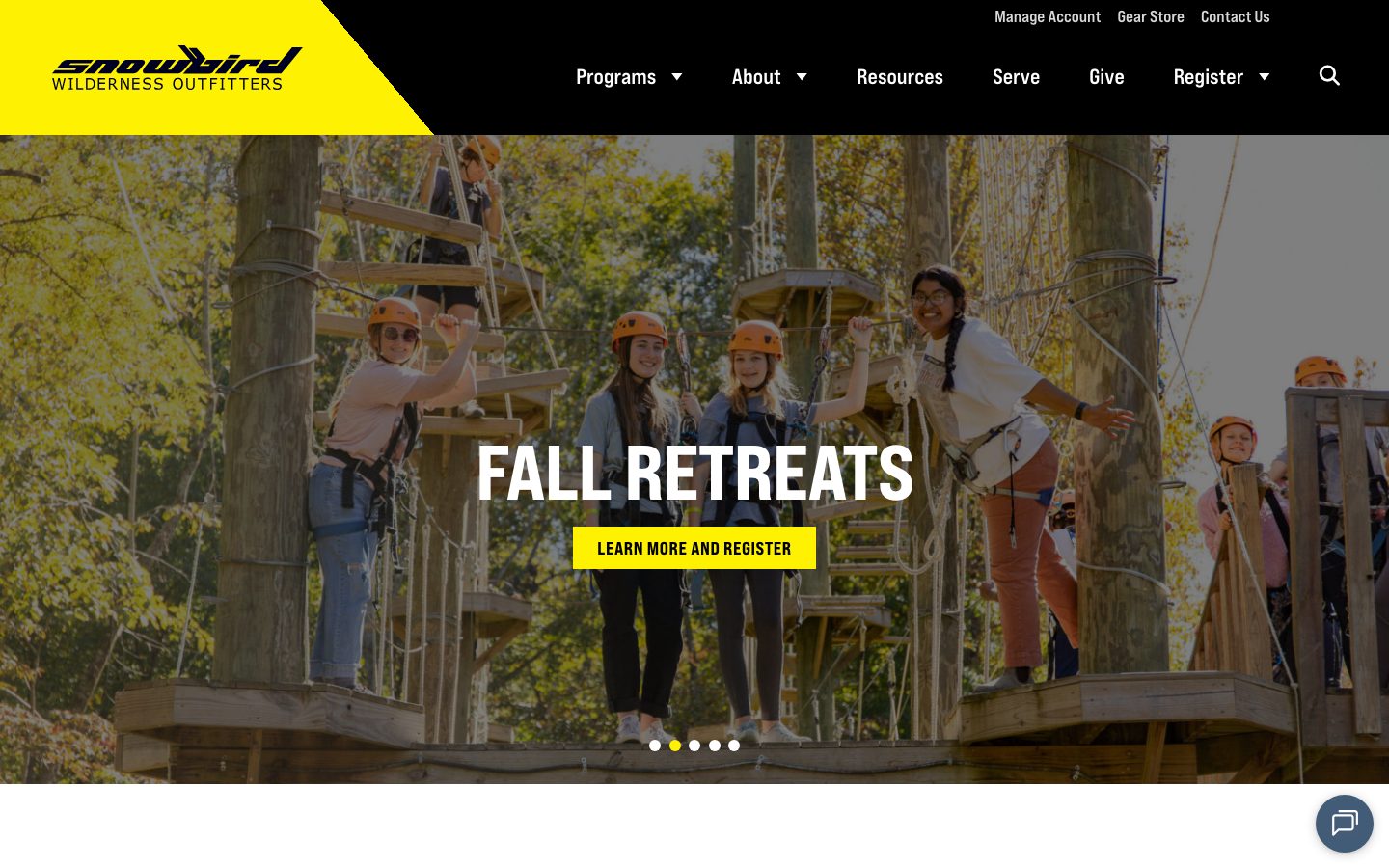
About Snowbird Wilderness Outfitters
Snowbird runs summer camp, missions camp, youth retreats in the fall, winter, and spring, a residential Institute for college-age students, and a full calendar of adult conferences: a men’s conference, a women’s retreat, a marriage conference, a college retreat. The model is simple. Church groups come to the mountains, do hard things outside, and sit under expository Bible teaching for a week. Then they go home.
That last part is where the website comes in. For most of Snowbird’s history, the ministry’s reach was the reach of its church network. Pastors recommended it. Youth groups came back every summer. It worked, and it was capped by exactly the people who already knew about it.
I ran Snowbird’s website from 2011 until I left staff in November 2025 to start Gridwork. Snowbird was one of the first clients to come with me. This is the story of what fifteen years of steady content and SEO work built, told with the numbers Google keeps.
The Problem
A camp website has a very short list of pages that make money: the program pages. Summer camp, men’s conference, marriage conference, the retreats. A church group books a week, and that is the whole business.
The trouble is that nobody searches for those pages until they already know Snowbird exists. “Christian camp North Carolina” is a real query, but it is a small one, and a group that has never heard of Snowbird is unlikely to type it. The people Snowbird most wants to reach, youth pastors and church leaders across the Southeast, do not spend their days searching for camps. They spend their days searching for what to teach on Sunday.
So the site had two jobs that pull in different directions. Rank the eleven program pages for the handful of searches that mean “I am ready to book.” And build a reason for the other 99 percent of the audience to find swoutfitters.com at all.
There was also the ordinary problem every ministry has: a small team, a lot of teaching, and no one whose job was to turn the teaching into something Google could find.
When I took over the website in 2011, the blog was a collection of devotional thoughts and short stories from the director. The sermon podcasts had no archive anywhere: not on Apple, not on Spotify, not on the site. Even the logo was inconsistent from page to page. There was a lot of teaching, and almost none of it was findable.
The Solution
Turn the teaching into a library
Snowbird produces an enormous amount of teaching. Every camp week, every conference, every retreat generates sermons, study guides, and small-group material. Two weekly podcasts have been running since 2020. Most ministries let all of that live and die on the weekend it was delivered.
The strategy was to treat that material as the raw asset it is, and publish it as a public library organized around the questions people actually type into Google.
That library is now roughly 159 articles, 158 study guides, 310 podcast episodes, and 1,400 session recordings, published between 2012 and today. The teaching came from Snowbird’s staff. The library came from a small marketing team, at different points fifteen people, that I had the privilege of leading. I wrote the pieces aimed at the program searches myself, set the article strategy that supported each program, and owned the SEO behind everything else: the titles, the URL structure, the internal links, the seasonal timing, and the ongoing decisions about what gets written, updated, or left alone.
The two weekly podcasts got the same treatment. Every episode is published to the site with a title and description written for search, and the archive is repurposed across the website and email so that a sermon recorded once keeps working for years. The email list is the other half of that loop: it grew from 7,000 subscribers to more than 30,000 over my years there, and it is where the library gets its second reading.
The first steps were unglamorous: get the logo consistent, decide which areas of the site would actually be kept current, and make the program pages describe what Snowbird does well. From there the resource areas were built one at a time, over years. Two podcast channels with full archives. Study guides tied to programs, to books of Scripture, and to holidays and seasons of the year. And a long run of articles drawn from sermons, so that someone with a specific question could find the ten minutes of a sermon that answered it without sitting through the full hour.
Most of the work is organizing and indexing: listening for the sections of a sermon that answer a question people actually search, pulling those out, and putting them on a silver platter for the person who needs them. That is the whole method. It is not fast, and it does not look like marketing while you are doing it.
Write for the question, not the event
The best-performing pages on swoutfitters.com are not about Snowbird. They answer a question a Christian somewhere is asking, and they answer it well enough that Google keeps sending people.
A few examples, with what Google Search Console reports for each over the last sixteen months:
- 25 Advent Hymns That Hope in Jesus (published November 2021). 5,689 clicks and 249,000 impressions. It ranks in the top five for “advent hymns” and top three for “christmas songs about hope,” and it does that every December without being touched.
- The Ephesians 5 Man: A Husband’s Biblical Love (January 2023). 4,152 clicks and 326,000 impressions. Position 2.4 for “ephesians 5 man.”
- The Five Pillars: The 5 Daily Prayers of Islam (December 2021, part of the Reaching Muslims During Ramadan study series that started in 2019). 3,160 clicks and 1.12 million impressions. Every Ramadan the series comes back around.
- 14 Lessons Paul Teaches Us in Acts (February 2022). 13,870 clicks and 1.11 million impressions. It is the second most-visited page on the entire site, behind only the homepage.
- Faith That Rejoices, Habakkuk 3:17 to 19 (August 2025). 9,347 clicks in its first year. Position 4 for “habakkuk 3 17-19.”
- Lessons from the Life of Samson (February 2025). 6,497 clicks. Position 1.9 for “5 lessons from the life of samson.”
Notice the dates. A page written in 2021 is still one of the site’s top ten in 2026. That is what evergreen means when it is real. Nothing about this compounds unless the content is good enough to keep earning, and the site around it is maintained well enough to keep ranking.
Keep the program pages sharp
The library brings people in. The program pages have to close. They are the only part of the site that turns a search into a booking, and they convert search impressions at 4.21 percent, roughly seven times the rate of the library.
So they get the boring, careful work: current dates, current pricing, keyword-first titles, clean meta descriptions, and internal links from the library pages that youth pastors are already reading. The men’s conference page alone drew 5,953 organic clicks in sixteen months, and the summer camp page holds position 4.6 on average across its queries.
The searches that matter most are the ones a stranger types when they are ready to book, and those are where the program pages rank. “Christian men’s conference” sits between positions 1.8 and 2.9 across its variants. “Christian marriage conference 2026” is at 3.2. “Christian women’s retreat 2026” is at 3.6. None of those searchers had to know Snowbird’s name first.
Manage the site like an asset
Fifteen years is several website generations. Over that time the site went through multiple redesigns and rebuilds (designed and built by Openbox9, not by me), two podcast relaunches, an app, and the usual churn of plugins, hosting, and platforms. The one constant was that someone was watching the SEO through every transition: preserving URLs, redirecting what moved, and making sure a redesign never quietly deleted a decade of rankings.
That is the unglamorous half of this case study and probably the more important one. Most of the pages listed above would have been lost at least once if nobody had been minding them.
Before vs. After
| Where Snowbird started | Where Snowbird is now |
|---|---|
| Reach limited to the church network that already knew the camp | 160,729 organic visits from Google in sixteen months, 73 percent from the US and the rest from more than 200 other countries |
| Teaching delivered once and archived nowhere | A public library of 159 articles, 158 study guides, 310 podcast episodes, and 1,400 sessions |
| A camp website found by people searching the camp’s name | 47 percent of tracked clicks come from non-brand searches, on 931 different queries |
| 87,500 visits from Google in the first twelve months Fathom tracked (Nov 2022 to Oct 2023) | 120,000 visits from Google in the latest twelve (Sep 2025 to Aug 2026) |
| Average Google position 13.8 (March 2025) | Average Google position 8.0 (August 2026) |
| 410,000 monthly Google impressions (March 2025) | 1.14 million monthly Google impressions (August 2026) |
| No measurement of what the content earned | 4,555 ranking keywords, 374 in the top three, 49 featured snippets |
The Results
The library carries the site. Of every organic click Google sends to swoutfitters.com, 59 percent lands on an article, study guide, podcast page, or session. The homepage takes 21 percent. The program pages take most of the rest. Without the library, the site’s search traffic would be roughly one fifth of what it is.
Impressions nearly tripled in eighteen months. Monthly Google impressions went from 410,000 in March 2025 to 1.14 million in August 2026, and have held above a million a month since April 2026. Average position moved from 13.8 to 8.0 over the same window, which is the difference between page two and the middle of page one.
Clicks grew too, though not as fast. Monthly clicks rose 22 percent, from 8,724 to 10,681, with July 2026 the best month on record at 12,296. August 2026 was up 24 percent year over year. The gap between impression growth and click growth is not an accident, and it is worth being honest about: Google now answers a lot of Bible-study questions in an AI Overview above the results. Eighty-seven percent of Snowbird’s ranking keywords trigger one. The site is winning more of the page and getting a smaller share of the click, which is the same thing happening to every publisher of informational content right now. It is also the next thing to solve.
And it holds up over four years, not eighteen months. Search Console only keeps sixteen months, so the chart above starts in 2025. Fathom Analytics has tracked the site since late 2022, and the longer line tells the same story more slowly. Visits from Google per twelve-month window: 87,500, then 106,000, then 113,000, then 120,000. Google’s share of all site traffic rose from 25 percent to 42 percent over the same stretch. The low point was May 2023, at 5,600 visits from Google in a month, right after Google’s 2023 core updates cut into informational sites everywhere. Summer 2026 averaged 11,400 a month. Nothing about that line is dramatic. That is the point of it.
The rankings are broad, not lucky. SEMrush tracks 4,555 organic keywords for the domain: 374 in positions one to three, another 1,245 on page one, and 49 featured snippets. The estimated traffic value of that ranking footprint is about $53,000 a month, which is what it would cost to buy the same visits with ads.
The audience is global. Seventy-three percent of clicks come from the United States. The next five countries are the Philippines, India, Kenya, Nigeria, and South Africa. Google’s translated results alone generated 643,000 impressions. A Bible study written for a youth group in North Carolina gets read by pastors in Nairobi, which is a strange and good thing for a summer camp to be able to say.
What Comes Next
Snowbird became a Gridwork client in November 2025, and the work now is the work the numbers point to.
The library is the right asset aimed at a slightly wrong reader. The pages that rank are read by individual Christians looking up a passage; the people who book retreats are youth pastors looking for something to teach. Retitling and restructuring the existing study guides for the person who leads a group, adding a youth pastors hub, and linking every relevant guide to the retreat it belongs with are the current priorities. So is Event schema on all eleven program pages, and moving the marriage conference, women’s retreat, and fall retreat pages from the top of page two to page one in booking-window order.
None of that requires new content. It requires doing the next right thing with fifteen years of content that already exists. That is the whole point of building a library instead of running a campaign, and it is the same work Gridwork does for contractors under the Momentum System.
Our Services for Snowbird Wilderness Outfitters
- SEO and website management across swoutfitters.com since 2011: site structure, URL preservation through multiple rebuilds, internal linking, technical fixes
- Content marketing strategy for a library of articles, study guides, and podcast episodes built around real search demand
- SEO editing and publishing for content written by Snowbird’s teaching staff
- Local SEO and program page optimization for the eleven pages that turn a search into a booking, and for the “Christian camp North Carolina” searches that start with a place
- Podcast SEO for two weekly shows, so the audio archive ranks alongside the written library
- AI search optimization, the current phase: restructuring the library for direct answers now that 87 percent of its ranking keywords trigger an AI Overview
- Analytics and reporting through Google Search Console, SEMrush, and Fathom, with a live client dashboard
- Fundraising and email support as a separate lane from search
Where the Numbers Come From
Every figure on this page is from Google Search Console, SEMrush, or Fathom Analytics for swoutfitters.com, pulled between June and September 2026. No registration, attendance, or donor figures are used. The results Snowbird sees as a ministry are the work of a whole staff over many years; what is here is the part search engines can measure.
Ready to Build a Library Like Snowbird’s?
Snowbird did not get here with a campaign. It got here by publishing good teaching, structured for the people searching for it, and by keeping the site healthy for fifteen years while the library grew.
If your organization is sitting on years of expertise that nobody can find, that is the problem we solve.